
Access to digital tools, reliable information, and data-based resources is not always evenly distributed across European territories, especially in rural areas. Starting from this context, 4DATA DEMOCRACY, a European project funded under the CERV – Citizens, Equality, Rights and Values, works to revitalise rural European regions, transforming passive citizenship into active and informed participation.
The Italian Chamber of Commerce in Belgium actively contributes to supporting civic participation and strengthening the involvement of local communities, perfectly aligning with its ongoing commitment to high-level international partnerships capable of promoting impactful initiatives and enhancing fundamental European values.
Coordinated by Materahub in Italy, 4DATA DEMOCRACY brings together partners from various European countries with the common goal of helping local communities to better understand, collect, and use data as a tool for participation. The project follows four main phases - Discover, Dream, Design, and Deliver - guiding participants from identifying local needs and resources to co-creating practical solutions. Pilot activities will be carried out in rural areas in Italy, Croatia, Poland, Portugal and Spain.
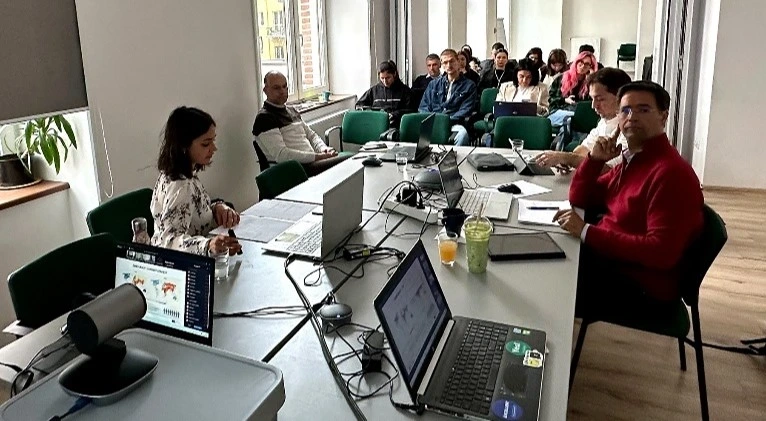
Far from remaining a mere statement of intent, the project has already consolidated its first foundations. On 28 and 29 April, the city of Łódź, in Poland, hosted the official launch of the Discover phase, bringing together project partners for an intense transnational training session.
During the event, Giulia Casot, on behalf of the Italian Chamber of Commerce in Belgium, and Dr. Pedro Espírito Santo, from the Politécnico de Leiria, conducted a hybrid training session on Data-Driven Democracy, guiding over 100 participants in exploring the contribution that data culture can offer to reducing the digital divide, addressing so-called “data deserts” and supporting more informed forms of civic participation.
Crucially, the CCBI was responsible for deepening the central theme of the EU Founding Treaties and Values, with a focus on promoting democratic participation, civic mechanisms, and current social challenges. Highly interactive, this session stimulated reflection and critical thinking, fostering meaningful debate among participants on community-led solutions.
WHAT’S NEXT?
Following the launch of the Discover phase, the project will now go into the field with the start of the Local Discovery Quests in all partner countries. These activities will engage local stakeholders in the collection of social and territorial data, not only to identify challenges but also to highlight existing strengths, good practices, and community resources.
This approach is designed to go beyond a problem-focused perspective. By recognising local potential and supporting citizens in the use of data, 4DATA DEMOCRACY aims to provide rural communities with the tools to recognise their own potential and actively co-create their future.